


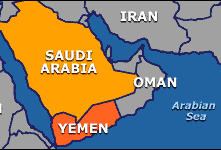
Iran continues its aggressive approach in the region and instability in Yemen
 The Kingdom of Saudi Arabia states that Iran continues its aggressive approach in the region and continues to interfere in the internal affairs of Arabic countries, which lead to instability and unrest in the region.

The instability and tension in Yemen is a consequence of Iran’s interference in Yemen with the aim to destabilize the country, disrupt its peace, and threaten its security. Iran seeks to incite sectarian sensitivities and to sabotage international efforts towards reaching a settlement of the Yemeni Conflict in accordance with UN resolution 2216 (issued in 2015). The Iranian Regime continues to support and encourage rebels by supplying them with arms, military experts, and missiles. This has led to instability and increased tension in the region, let alone to the suffering of the Yemeni People. The attacks against Saudi borders and Cities would not have been occurred without Iran’s intensified encouragement and support of the rebels in Yemen, which went as far as threatening international navigation.
The Kingdom emphasizes its right to protect its sovereignty and security, and thus calls upon the international community to take its responsibility and fulfil its duty by responding to the actions of the Iranian Regime, which resulted in instability of the region as well as aggression and interference in states’ internal affairs.
Coalition denies Yemeni funeral bombing
 SA News October 9, 2016
The Coalition supporting the legitimate government in Yemen was not involved in the strikes at funeral in Yemen. About it reports Reuters referring to a source in the Arabian coalition.
“Absolutely nothing was carried out in the region”, one of the Arabian coalition sources said, the coalition always avoid attacking such a crowd of people.
According to the statement carried by the Saudi Press Agency (SPA). The Coalition supporting the legitimate government in Yemen has announced that it is aware of reports about the regrettable and painful bombing of the Great Hall in Sana’a today 8/10/2016 , which led to the killing and and injuring of casualties, as reported.
The coalition expressed its deepest condolences and support to the families of the victims of hostilities since of the coup takeover of power in Yemen during 2014.
The coalition confirms that its troops have clear instructions not to target populated areaa and to avoid civilians.
The coalition will immediately investigate this case along with Joint Incidents Assessment Team (JIAT) in Yemen and experts from the United States who participated in previous investigations.
The coalition is also willing to provide the investigation team with any data and information related to its military operations today, at the incident’s location and the surrounding areas.
The result of the investigation should be announced as soon as it’s completed.
“Saudi Arabia’s Counter-Terrorism, Efforts” Exhibition opens in Canberra, Australia

Ambassador Al Saleh , Col. Sami Al-Mutairi with Military Attachés of numerous foreign embassies in Australia.
SA NEWS , Canberra, SEP 25,2016.
Saudi Arabia’s Counter-Terrorism Efforts” Exhibition organised by the Saudi military attaché at the Saudi Embassy in Canberra, was opened by the Saudi Ambassador to Australia, Nabil Al Saleh, and Ms Lyndall Sachs, Chief Protocol of the Australian Department of Foreign Affairs and Trade (DFAT) . The opening took place on the sidelines of the Saudi Embassy’s celebrations of the Saudi Arabian National Day.
The event was attended by senior embassy staff and Australian senior military representatives from the Royal Australian Defence Force, and Military Attachés of numerous foreign embassies in Australia.
In a statement to SPA, Ambassador Al Saleh highlighted the role being played by the Kingdom in combating terrorism and its humanitarian relief initiatives all over the world, “Their efforts emanate from its pioneering regional and international role to bring about peace and stability in the world” Ambassador Alsaleh Said .
On his part, the the Saudi military attaché in the Royal embassy of Saudi Arabia in Australian Col. Gen. Sami Ben Fahd Al-Mutairi explained the contents of the exhibition, including the presentations, posters, books and documentary films on display showing the Kingdom’s efforts to fight terrorism. The exhibition also highlights Saudi Arabia’s efforts in the formation of an Islamic alliance to fight terrorism and establish humanitarian relief, as represented in the King Salman Center for Relief and Humanitarian Aid .
Ambassador Al Saleh’s Remarks on Saudi National Day – Canberra, 2016
Saudi Ambassador to Australia and New Zealand Mr Nabil Al Saleh
Remarks at National Day 2016 Reception”
Speech, check against delivery, Canberra, Australia , 22 September, 2016
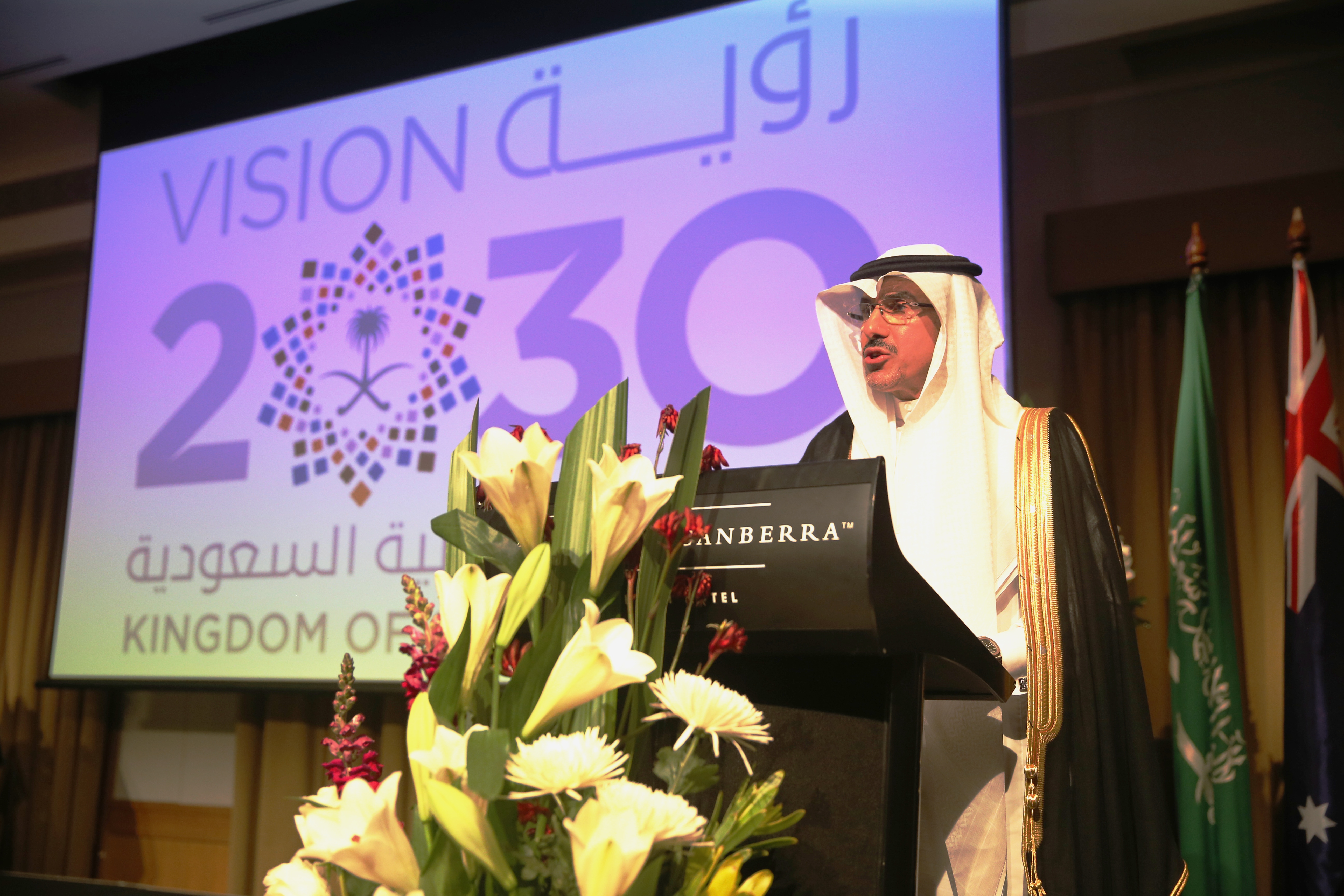 Excellencies, distinguished guests. It is my great pleasure to welcome you here tonight, as we celebrate the passing of 86 years since the unification of Saudi Arabia.
We have succeeded in this period beyond expectations. Today, Saudi Arabia has become a leading player in regional and international affairs. We have improved our standard of living. We have created opportunities for our people, and have built cities and a country of which we are proud of.
As you know, the region, and the whole world is changing fast, entering an era full of challenges. And this, in its own right, contributes to the introduction of new and unique opportunities, in building a more resilient and comprehensive economy.
For well over a decade, the Kingdom has enjoyed uninterrupted real economic growth, with an average growth rate of 5 % over the past 5 years. Whilst we are in a strong position, we understand the necessity to adapt to a new paradigm, to face whatever challenges and strains that may arise.
It is in this context that we have embarked on implementing Saudi Arabia’s long-term economic strategy. Vision 2030, announced by our government earlier this year, aims to transform our country; diversify our sources of income, into an economy that is vibrant and resilient.
Where we are changing the mind-set of the country from an oil producer, to an innovative, competitive, efficient society, as we unleash the potential of our youth. Where we are making ministries and government as a whole more accountable, setting the highest levels of transparency and governance across all sectors. Where we look at ways to increase foreign investment as well as domestic investment in Saudi Arabia, and empower the role of women.
However, ‘Vision 2030’ is much more than that. It is also about looking at sectors that have been underutilised. Whether it is in mining or manufacturing; whether it is in defence, services, or education; whether it is in research and technology. After all, ‘Vision 2030’ is not just a slogan – its baselines and fundamentals are non-negotiable. And these elements are what is central to the vision; which are:
– Our position as the heart of the Arab and Islamic worlds.
– Becoming a global and leading investment powerhouse.
– And, making Saudi Arabia a global epicentre of trade, connecting three continents; Asia, Europe and Africa.
That is why we have launched the ‘2020 National Transformation Plan’. A blueprint, which outlines the pathway to 2030; how we plan and monitor our work. It is a roadmap, which will ensure that ministries , institutions , and government entities work on implementing the Vision. The results of which will be published so that it can be publically monitored. It is because of this, that we are quite optimistic:
Of becoming within the world’s 15th largest economy by 2030, up from our current position of 19th in the world. Transforming our Public Investment Fund into the world’s largest sovereign wealth fund. Increasing its assets from $214 billion Australian dollars to over $2.5 trillion Australian dollars. As well as increasing the private sector’s contribution from 40% to 65% of GDP, and increasing Small and medium-sized enterprises’ contribution to GDP from 20% to 35%. And, of lowering the rate of unemployment from 11.6% to 7%.
Moreover, of moving ahead in global rankings. For instance, from our current position, of 82nd in the World Bank Index of Ease of Doing Business, to rank 20th by 2020. As well as from 25th to rank 20th in the Global Competitiveness Index within the coming four years.
But Ladies and Gentlemen,
‘Vision 2030’ signifies a lot of possibilities. I would encourage you to enter into constructive partnerships with us. True that ‘Vision 2030’ is entirely Saudi. That we will localise manufacturing, and harness the knowledge acquired by our nationals studying on government scholarships abroad. Which, at present, number in excess of 200 thousand.
But the private sector has an integral role to play in fulfilling our vision. And so, the opportunities for you are there. Particularly as we need the skills, the expertise and technical know-how.
Indeed, Saudi Arabia has, is, and will continue to be an appealing investment destination. And these activities and opportunities will not cease. Whether it is in Health, Defence, Education, Mining, Food Security, Infrastructure, services, or ICT just to name a few. Sectors that Saudi Arabia and Australia can work on closely together. But let me just briefly illustrate some of the possibilities:
Although we are the world’s 3rd biggest military spender, only 2% of this spending is within the Kingdom. We intend to localise over 50 % of military equipment spending by 2030. Doing so, will require strategic partnerships with the private sector.
Moreover, we see ourselves not as an oil producing country, but an energy producer – in solar, in wind, in clean energy. We intend to generate 9.5 giga-watts of renewable energy to meet our local energy consumption, which is set to increase three fold by 2030. In doing so, we are entering into partnerships with institutions across the world, in research and technical collaborations.
Furthermore, we have established the Commission for Recreation and Culture, and have sought international interests in offering cultural activities and entertainment inside the Kingdom.
These changes will come in tandem with a population that is set to double over the coming decades. As well as an increase in disposable income, and a growth in the number of annual travellers.
These will evidently lead to a strong rise in the demand for food and food security. Religious travel alone is set to expand from 8 million to 15 million visitors by 2020, and to 30 million visitors per annum by 2030.
There will continue to be ample opportunities in the education and research field. Particularly as we seek to train over half a million public sector employees by 2020. We will also encourage further collaboration and partnerships between our educational institutions and foreign universities. Particularly as we aspire to have five Saudi universities in the top 200 world universities by 2030.
Last but not least, the ICT sector will play an integral role, as it will drive this Vision, empowering our country, and economy. It is worth remembering that Saudi Arabia is the largest ICT market in the Middle East region.
I could go on and on.
But my point is that all government departments are working in sync with the private sector to translate the vision into a reality. We are pulling the pieces together from all over Government and relevant bodies. The foundations are being laid. Vision 2030, and the mechanisms worked through as stated in the 2020 National Transformation Plan, has provided the means and the necessary assurances for investors to act with confidence.
It is in this regard that I should refer to the visit by the Australian Minister of Trade and Investment to Saudi Arabia in the near future. I would encourage Australian businesses to accompany the Minister in this trip, or to seek the assistance provided by the Saudi Australia Busines Council. As it is a valuable vehicle to discover the transformation occurring on the ground, discuss the possibilities with the relevant officials, as well as prospective busines partners.
We know that the current trade balance between both our nations does not reflect its true potential. Thus, seizing the opportunities currently presented, will turn the potential for exponential growth into a reality. So, let me conclude by emphasising to you that: Saudi Arabia has chosen a clear path. A path of creating an economy that is not dependent on oil as a source
of revenue. Making it a global and leading investment powerhouse, as well as a global epicentre for trade. All of which will be based on good governance, transparency, and accountability.
In doing so, we look forward to working with all members of the business community, and international community, in our path to accomplish Vision 2030.
Thank you very much for your attendance.
Saudi Crown Prince meets Australian PM on sidelines of UNGA

Saudi Crown Prince meets Australian PM on sidelines of UNGA
SA News New York 20-9-2016
Saudi Crown Prince Mohammed bin Nayef has met on Tuesday with Australian Prime Minister Malcolm Turnbull on the sidelines of the United Nations General Assembly (UNGA).
During the meeting, they reviewed bilateral relations between Saudi Arabia and Australia and ways of enhancing them, in all fields, in addition to issues of mutual interest.
According to a News report by AAP Malcolm Turnbull has had a frank discussion with Saudi Arabia’s deputy prime minister about how to fight” ISIS-Daesh” and its propaganda machine.
The discussion also focused on the difficulties of creating a clear path towards a political settlement in Syria.
The prime minister also reiterated Australia’s commitment to negotiating a free trade agreement with the Gulf Cooperation Council.
Muslim World League Conference in Mecca: Islam is a Message of Peace and Moderation
 SA News Mecca 13th September 2016
The Muslim World League held a ” Islam is a Message of Peace and Moderation” ,Conference in Mecca this week , attended by the prominent Muslim scholars around the world .
The participants have applauded the outstanding Islamic services provided to the pilgrims of the Sacred House of Allah, as this facilitated for them the performance of their Hajj ritual in security, and peace of mind. And conveyed their profound thanks and appreciation to Custodian of the Two Holy Masjids King Salman Ibn Abdul Aziz Al Saud for the Islamic glorious service that Allah helped him to render rendered to the Two Holy Masjids.
The participants strongly denounce the statements issued by certain Iranian officials and theorists of its sectarian the directions regarding their flagrant intervention in Hajj affairs in the context of their annual customary activity, which fell short of even elevating itself to the higher objectives of Islam.
Ambassador Al Saleh launches the Saudi date distribution program in Australia
 Ambassador of Saudi Arabia in Australia and New Zealand Nabil Al Saleh launched today the Saudi Date distribution program as a gift from the Custodian of the Two Holy Mosques King Salman bin Abdulaziz Al Saud, “God protect him” to Muslims in Australia, New Zealand and neighbouring islands on the occasion of the Holy Month of Ramadan.
Ambassador Al Saleh pointed out that the Embassy has distributed nearly six tonnes of dates across more than 120 associations and Islamic Centres and individuals in Australia, New Zealand and countries neighbouring islands in Fiji and Papa New Guinea and others during the Holy Month. H.E said the program is one of the charity initiatives undertaken by the Kingdom during the holy month of Ramadan.
Ambassador congratulates Victoria University on Centenary

Ambassador Al Saleh with Victorian University Chancellor George Pappas
The Ambassador of Saudi Arabia in Australia Nabil Al Saleh met with the Chancellor of the University of Victoria, Professor George Pappas, at a Ceremony to commemorate the Centenary of the founding of Victoria University in Australia. The celebration took place in the attendance of senior political, academic and diplomatic figures including a representative of the Prime Minister Malcolm Turnbull, the Australian Federal Education Minister Simon Birmingham and Minister of Education in Victoria, James Mirlino and the Saudi cultural attaché to Australia, Dr. Abdul Aziz Ibn Taleb.
Ambassador Al Saleh congratulated Mr Pappas on the occasion of the Centenary, and noted the University’s embrace of many Saudi students on scholarships. He also praised the depth of academic and cognitive relations between Saudi Arabia and Australia and pointed to the prospects of seeing Saudi Arabia’s “2030” vision to include education as a key player in the Saudi economy and in its future.
On his part, the University Chancellor George Pappas, praised the academic relations between the University of Victoria and Saudi Arabia, directing his thanks and appreciation to Ambassador Al Saleh for his participation in the Ceremony. He also noted the great cooperation and interest shown between both nations to strengthen these relations.
Governor-General hosts luncheon honouring Mr Iyad Madani of the OIC

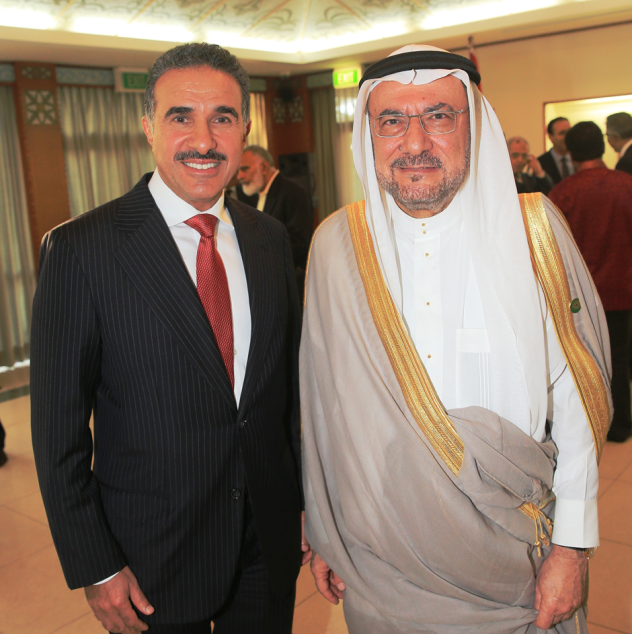
The Governor-General hosted a luncheon in honor of the Secretary General of the OIC Mr Iyad Madani
SA NEWS – 3 February 2016
The Governor-General General the Honourable Sir Peter Cosgrove and Lady Cosgrove hosted a lunch on the occasion of the visit to Australia by His Excellency Mr Iyad Ameen Madani, Secretary General of the Organisation of Islamic Cooperation. Guests included:
Ambassador of Saudi Arabia in Australia His Excellency Mr Nabil Mohammed A. Al Saleh; His Excellency Dr Abdusalam Abadi , Ms Maha Aqeel; Dr Dodik Ariyanto; Mr Ahmed Fahour; Senator the Honourable Concetta Fierravanti-Wells; Mr Ammanul Haq; Mr Ridwaan Jadwat; Mr Ahmad Madani; Mr Chris Moraitis; Mr Greg Ralph; His Excellency Mr Nadjib Riphat Kesoema; Professor Amin Saikal AM; Mr Bilal Sasso; Ms Maria Vamvakinou MP; and Mr Peter Varghese AO.
Secretary General of (OIC) Iyad Madani Arrives in Canberra
.Secretary General of the Organization of Islamic Cooperation (OIC) Iyad Ameen Madani has arrived today in the Australian capital of Canberra as part of his official visit to Australia
.He was welcomed by Saudi Ambassador to Australia Nabil Al Saleh and various Australian officials
Recent Posts
- Saudi surgeons successfully separate Fijian conjoined twins
- Al-Issa’s visit highlights Australia’s multifaith future
- Saudi Ambassador to Australia Receives Muslim World League Secretary-General
- Australian Saudi Business Council and Forum hosts Ramadan iftar in Sydney
- Saudi Heritage Shines at Canberra’s National Multicultural Festival 2026
Recent Comments
Archives
- October 2026
- April 2026
- March 2026
- February 2026
- September 2025
- August 2025
- May 2025
- February 2025
- September 2024
- June 2024
- May 2024
- February 2024
- November 2023
- October 2023
- September 2023
- April 2023
- March 2023
- February 2023
- December 2022
- November 2022
- October 2022
- September 2022
- July 2022
- September 2021
- July 2020
- February 2020
- January 2020
- September 2019
- February 2019
- January 2019
- March 2018
- February 2018
- January 2018
- December 2017
- November 2017
- October 2017
- September 2017
- August 2017
- December 2016
- November 2016
- October 2016
- September 2016
- August 2016
- June 2016
- May 2016
- February 2016
- January 2016
- December 2015
- October 2015
- July 2015
- May 2015
- April 2015
- November 2014
- October 2014
- August 2014
- July 2014
- April 2014
- March 2014
- February 2014
- December 2013
- November 2013
- October 2013
- September 2013
- August 2013
- July 2013
- June 2013
- May 2013
- April 2013
- February 2013
- December 2012
- October 2012
- September 2012
- August 2012
- July 2012
Categories
- 2009
- 2010
- 2011
- 2012
- 2013
- 2014
- 2015
- 2016
- April
- April
- April
- Arabic
- August
- Combatting Terrorism
- December
- December
- December
- December
- December
- December
- English
- February
- February
- February
- February
- January
- July
- July
- June
- June
- June
- June
- March
- March
- May
- May
- May
- May
- November
- November
- October
- October
- Photo Gallery
- SA News
- SA TV
- Saudi Australia Relations
- SAUDI BULLETIN
- Saudi Issues
- Saudi Vision 2030
- September
- September
- September
- September
- September
- September
- Uncategorized