


Iran’s Record in Supporting Terrorism
Iran’s Record in Supporting Terrorism and Extremism
Jan 20, 2016

A senior official of Saudi Arabia’s Foreign Ministry stated today that since the Iranian revolution in 1979, Iran has established a record of spreading sedition, unrest and chaos in the region in an effort to undermine the region’s security and stability, and in complete disregard for international law, agreements, treaties, and moral principles. During the same period, the Kingdom has maintained a policy of restraint in spite of having suffered – as have neighboring countries – the consequences of Iran’s continued aggressive policies.
The official said that Iranian policy is based primarily on the preamble of Iranian constitution and the directive of Ayatollah Khomeini, which is based on the idea of exporting revolution. In a flagrant violation of the sovereignty of other states and interference in their internal affairs, Iran recruits militias in Iraq, Lebanon, Syria, and Yemen under what is called ‘supporting the vulnerable and subjugated peoples. It continues to support terrorism by providing safe havens for terrorist organizations on its territory, planting terrorist cells in a number of Arab countries, and assisting in terrorist bombings that have caused the loss of many innocent lives. It has assassinated opposition figures abroad, has continually violated the sanctity of diplomatic missions, and has even assassinated or attempted to assassinate diplomats around the world.
The Minister of Foreign Affairs has prepared by the attached fact sheet to illustrate Iran’s aggressive policies over nearly four decades, and categorically refutes the persistent lies promoted by the Tehran regime, including the foreign ministers article in The New York Times and his message to the Secretary-General of the United Nations.
FACT SHEET: Iran’s Record in Supporting Terrorism and Extremism
- The Iranian regime is the worlds number one sponsor of terrorism. The Quds Force and other state and state-sponsored organizations actively engage in and support terrorist organizations abroad, such as Hezbollah, Hezbollah Al-Hejaz (Saudi Hezbollah), Asa’ib Ahl al-Haq in Iraq, and a number of sectarian militias, including Houthis in Yemen. Iran has supported and conspired with other terrorist organizations, such as Al-Qaeda. Iran has harbored Al-Qaeda leaders, some of whom still enjoy sanctuary in Iran. Iran has been condemned by the United Nations and many countries. International sanctions have been imposed on it.
- In 1982, 96 foreigners were kidnapped in Lebanon, including 25 Americans, in what is known as the hostage crisis which lasted for10 years. Most of kidnappings were carried out by Hezbollah and other Iranian-backed groups.
- Hezbollah bombing of the U.S. embassy in Beirut in 1983, which killed 63 people, was orchestrated by the Iranian regime.
- Also, in 1983, Ismail Ascari, an Iranian national, carried out a suicide bombing at the U.S. Marine Corps barracks in Beirut. The attack was planned by Iran and resulted in the deaths of 241 American servicemen and injuries to 100. It was described by the American press as the largest single group of casualties outside the battlefield.
- On the same day, Hezbollah also sent a suicide truck bomber to the French army barracks in Beirut, which resulted in the deaths of 64 French civilian and military personnel.
- In 1983, members of Hezbollah and the Shiite Hezbo-AlDawa, which were backed by Iran, carried out a number of attacks, including attacks on the U.S, and French embassies in Kuwait, an oil refinery, and a residential neighborhood, resulting in the deaths of five people and the wounding of eight.
- In 1983, Iran attacked Kuwaiti oil tankers in the Gulf. Subsequently, Kuwait tankers were reflagged as American and provided escort by U.S. warships.
- In 1984, Hezbollah attacked a US Embassy annex in east Beirut, resulting in the deaths 24 people.
- In 1985, several Gulf soldiers and citizens were killed when an attempt was made to bomb the motorcade of His Highness, late Sheikh Jaber Al-Ahmad Al-Sabah, Amir of Kuwait.
- In 1985, the Iranian regime masterminded the hijacking of TWA flight; 39 American passengers were held captive for weeks.
- In 1986, Iran urged its pilgrims to carry out riots during Hajj season, which resulted in a stampede and the deaths of 300 people.
- Hezbollah Al-Hejaz set fire to an oil facility in Ras Tanura on the east coast of Saudi Arabia in 1987. In that same year, The pro-Iranian organization attacked the Saudi Petrochemical Company (SADAF) facility in Jubail, in eastern Saudi Arabia.
- In 1987, Iran was involved in the murder of Saudi diplomat Mosaed Alghamdi in Tehran, the same year Saudi Arabia foiled attempts by Iranian pilgrims to smuggle explosives in to the country.
- In 1987, the Saudi embassy in Tehran was attacked and Saudi diplomat Reza Abdulmohsen Al-Nozha was assaulted and taken by Iranian Revolutionary Guard forces. He was released following negotiations between Saudi Arabia and Iran.
- Iranian surrogates were responsible for the abductions and killings of a number of American diplomats in Lebanon in the 1980s.
- Iran was involved in a series of assassinations of Iranian opposition members, including:
- a.The murder of Iranian Kurdistan Democratic Party leader Rahman Ghassemlou and his deputy Abdullah Azar, in Vienna in 1989.
- The assassination in France by the Iranian revolutionary guard of Shapour Bakhtiar, the last Prime Minister of Iran under Shah Mohammad Reza Pahlavi, which also took the lives of a French officer and woman.
- The assassinations of Secretary-General of the Kurdistan Democratic Party, Sadegh Sharafkandi, his assistants Fattah Abdoulie, Homayoun Ardalan, and Nuri Dechrda, in the bombing of the Mykonos restaurant in Berlin in 1992.
- The Iranian regime kidnapped and killed a number of American diplomats in Lebanon in 1989 Iran was responsible for the abduction and killing of a number of U.S. diplomats in Lebanon in the 1989.
- The Iranian regime was involved in the assassination in Thailand of Saudi diplomats Abdullah Al-Malki, Abdullah Al-Bassri, Fahad Al-Bahli, and Ahmed Al-saif in 1989 and 1990.
- In 1992, the Iranian regime was involved in the bombing of Mykonos restaurant in Berlin. The German Federal Prosecutor issued an arrest warrant of Iran’s Minister of Intelligence, Ali Fallahian, for planning and supervising the restaurant bombing and killing (4) Kurdish opposition who were in the restaurant at the time of the bombing.
- Iran was involved in Buenos Aires bombings in 1994, which resulted in the deaths of 85 people and the wounding 300 others. In 2003, British police arrested Hade Pour Soleimanpour, Iran†s former ambassador to Argentina, for conspiring to carry out attack.
- In 1994, the Venezuelan Ministry of Foreign Affairs issued a press release stating that four Iranian diplomats were involved in a covert operation at Simon Bolivar International Airport in Caracas that was aimed at forcing Iranian refugees to return to their country.
- Iran was involved in the Khobar bombings in 1996, which was carried out by the pro-Iranian organization Hezbolla-Al Hijaz and resulted in the deaths of 120 people, including 19 Americans. Iran provided protection to the offenders, including Ahmed AlMoghassil, a Saudi citizen who was arrested in Lebanon in 2015 carrying an Iranian passport. The terrorist attacks were directed by the Iranian military attachأ in Bahrain. The perpetrators were trained in both Lebanon and Iran. The explosives were smuggled from Lebanon to Saudi Arabia by Hezbollah. Evidence is available with Saudi Arabia and the governments of a number of friendly countries.
- Iran has provided a safe haven for a number of Al-Qaeda leaders since 2001, including Saad bin Laden, Saif Al-Adel and others after September 11, 2001. It refuses to hand Al- Qaeda leaders over to Saudi Arabia despite the Kingdom†s continuous requests.
- Iran was involved in the bombings of three residential compounds in Riyadh in 2003, which killed many Saudi citizens and foreign residents, including Americans, at the instruction of one of the Al-Qaeda leaders in Iran.
- In 2003, the Kingdom of Bahrain arrested members of a new terrorist cell that was receiving support from the Iranian Revolutionary Guard and Hezbollah in Lebanon, Kuwait and the United Arab Emirates.
- In 2003, the Iranian regime supported Shiite elements in Iraq by forming political parties and militias loyal to Iran. These activities resulted in the deaths of some 4,400 U.S. service members and tens of thousands of civilians, particularly of Sunni Arabs. Former U.S. ambassador to Iraq James Jeffrey said that the Americans who died were killed in operations carried out by groups backed directly by Iran.
- In 2006, Washington said that Iran supported the Taliban against US forces in Afghanistan and that it had armed groups different ethnic and sectarian groups to strike the US near Iran†s borders. It said further that the Iranian regime had offered a reward of $1000 for every American soldier killed in Afghanistan.
- In 2007, the US Senate passed a resolution calling the Iranian Revolutionary Guard a terrorist organization. this has been the characterization of this group by President George W. Bush and Congress are indicative according to rules issued after the Sept. 11, 2001.
- In 2011, Iran was involved in the assassination of Saudi diplomat Hassan Al-Qahtani in Karachi.
- In 2011, the U.S. foiled an attempt to assassinate the Saudi ambassador to the U.S. and proved the involvement of the Iranian regime. The criminal complaint unveiled in federal court in New York identified two people involved in the plot: Mansour Arbabsear, who was arrested and imprisoned for 25 years, and Gholam Shakuri, an officer in the Iranian Revolutionary Guard, who is currently in Iran and wanted by the U.S. judiciary.
- In October 2012, hackers from Iran’s Revolutionary Guard carried out cyber-attacks against oil and gas companies in Saudi Arabia and the Gulf. U.S. Defense Secretary Leon Panetta described the cyber-attacks as among the most destructive in the private sector. President Obama’s administration said that it is aware that this is the work of the Iranian government.
- In 2012, a plot to assassinate US officials and diplomats in Baku, the capital of Azerbaijan, was discovered. A Shiite group in Azerbaijan, backed by Iran and working under the instructions of the Revolutionary Guard, was behind the plot.
- In 2016, the Kuwaiti criminal court sentenced two members of the “Abdali cell†to death. One has Iranian citizenship. They were charged with carrying out acts that jeopardize the unity and security of Kuwait, and with actively collaborating with Iran and Hezbollah to carry out acts of hostility.
- In January 2016, Iran admitted officially through the commander of the Iranian Revolutionary Guards, Mohammad Ali Jafari, that it had 200 thousand Iranian fighters outside the country – in Syria, Iraq, Afghanistan, Pakistan and Yemen.
- Iranian diplomatic missions form spy networks in different countries to plan and execute terrorist operations. The countries that discovered that Iranian spy networks exist on their territory were: the Kingdom of Saudi Arabia in 2013, Kuwait in 2010 and 2015, Bahrain in 2010 and 2011, Kenya in 2015, Egypt in 2005, 2008, 2011, Jordan in 2015, Yemen in 2012, the UAE in 2013, Turkey in 2012, and Nigeria in 2015.
- In addition to Hezbollah in Lebanon, which was described by U.S. Deputy Secretary of State Richard Armitage as the number one terrorist organization in the world, the Iranian regime founded many terrorist cells and militias in Iraq, Yemen and other countries, and used them to destabilize.
- Iran sent members of the Revolutionary Guard to Iraq to train and organize Shiite militias and use them to kill Sunnis and international forces.
- Iran is the largest distributor of IED explosives in the world. IEDs are used to blow up cars and armored vehicles and have caused the deaths of hundreds of members of international forces in Iraq.
- Iran has violated the sanctity of diplomatic missions, including the attack on the U.S. embassy in 1979 and the detention of its employees for 444 days, the attack on the Saudi Embassy in 1987, the attack on the Embassy of Kuwait in 1987, the attack on the Russian Embassy in 1988, the attack on the Danish embassy in 2006, the assault on a Kuwaiti diplomat in 2007, the attack on the Pakistani embassy in 2009, the attack on the British Embassy in 2011, and the attack on the Embassy of the Kingdom of Saudi Arabia in Tehran and its consulate in Mashhad in 2016.
- The Iranian regime did not protect Saudi diplomatic facilities during the 2016 attacks, despite repeated requests. Security men even entered the embassy building after the attacks and stole its property.
- Saudi Arabia is not the first country to cut off ties with the Iranian regime as a result of its acts of aggression and violation of the sanctity of embassies. The United States, Britain, Canada and other European countries preceded Saudi Arabia. Algeria, Tunisia, Egypt, Morocco and Yemen also severed ties. Recently, Bahrain, Sudan, Somalia and Djibouti have cut off relations with Iranian regime because of Iran†s interference in their affairs and for the connection between the Iranian regime and sponsoring terrorism.
- .While the Kingdom has been a target of many terrorist attacks, the Iranian regime has not been exposed to any acts of terrorism, whether from Al-Qaeda or Daesh, giving weight to suspicions that Iran is working with terrorist organizations.
- The Arab region did not know sectarianism until after the Iranian revolution in 1979. Iran has interfered in Lebanon, Syria, Iraq and Yemen. One of its agents, Heidar Moslehi, the former Iranian Minister of Intelligence, ranted that Iran occupies four Arab capitals.
- The Iranian regime seduced many Gulf citizens by taking advantage of their religious feelings and smuggling them illegally to Iran. They traveled covertly through third countries with no visas, and their Iranian handlers instructed them to leave by boat and venture into international waters, where Iran picked them up and claimed to rescue them. The Iranian regime enrolled them in training for armed operations and other terrorist acts and took them back to their countries to carry out these acts.
- Perhaps the greatest example of Iran†s interference is its flagrant interference in Syria through its Revolutionary Guard forces, the Al-Quds Force and the recruitment of Hezbollah militia and sectarian militias from a number of countries to fight alongside the regime of Bashar al-Assad.
- The Iranian interference in the affairs of the Arab region was strongly rejected by the Arab League in all its decisions, including its last meeting on Jan. 10, 2016.
- Iran claim that its embassy in Yemen was bombed was disproved by facts backed up with photos.
- Iran fabricated the claim that one of Makkah†s imams spoke negatively about Shiites. Audio and videos of all the speeches of the imams of the Holy Mosque disprove this charge.
- Nimr Al-Nimr, a person whom Iran calls a peaceful political activist, was convicted of terrorism charges along with 46 others. He was convicted of establishing a terrorist cell that plans and executes terrorist acts and recruits and arms people to carry them out. Those acts that have resulted in the deaths of a number of security officers.
- The Iranian regime was condemned by the international community and the United Nations for human rights violations and its support of terrorism, which was confirmed by UN General Assembly Report A70/411 issued October 6, 2015.
- According to international reports, Iran executed more than 1,000 people during 2015, an average of three executions a day. The pace of these executions increased during the first seven months of 2015. The Iranian Supreme Court approved the executions of 27 Sunni preachers without any justification.
- Iran continuous to repress its minorities, including Arab Ahwaz, Kurds, and Baluchs.
- Iran is in violation of Security Council Resolution 2216 with regard to Yemen because it continues to supply weapons to the Houthi militias. Iranian ships carrying weapons, including rockets, were intercepted on their way to the Houthis in Yemen.
- The Iranian regime claims to protect its agents, but does not hesitate to get rid of them as soon as their terrorist acts are discovered. This happened to one of those who participated in Khobar bombing.
- Iran foreign minister’s allegation that Saudi Arabia opposed the nuclear agreement is not true. Saudi Arabia publicly supported any agreement that would prevent Iran from acquiring a nuclear weapon and includes a rigid and consistent inspection mechanism, with the option of imposing sanctions should Iran violate the agreement, which was affirmed by the United States.
- Iran should determine whether it is a revolution in a state of chaos and disobeys international laws or a country that respects international agreements and treaties and the principles of good neighborliness and non-interference in the internal affairs of other countries.
- Since the beginning of the Iranian revolution, Saudi Arabia has tried to reach out to Iran in peace, harmony, peaceful co-existence and good neighborly relations, but Iran responded by spreading sectarianism, provocation, killing and destruction.
- If Iran wants to show reason and logic, it must start with itself before asking others to do so.
Saudi Ambassador Speech: ALCC Awards Night
Ambassador Nabil M. Al Saleh – Remarks at The Australian Lebanese Chamber of Commerce, Diamond Anniversary
Saturday 28 NOVEMBER 2015 – Doltone House, Darling Island Wharf , Sydney
I’ll begin by thanking The Charmain of the Australian Lebanese Chamber of Commerce Joe Khattar, for inviting me here today. And congratulate him and his Chamber for the significant contributions they have made over the past 30 years.
Can I also acknowledge the Honourable Minister of Agriculture, Barnaby Joyce, the Honourable Minister John Ajaka, all parliamentarians and government officials. And of course my diplomatic colleagues.
Ladies and gentlemen,
It is a privilege to speak to such a distinguished audience.
Keeping my talk brief, I want to focus here tonight on the economic opportunities the MENA region has to offer, a matter which is often overlooked.
Because when looking at the MENA region, it is often the case that our region is viewed by Australian businesses as distant and too complex to conduct business in.
As a result, businesses focus overwhelmingly on the familiar.
It is indeed true that this is the “Asian Century”, but this century shouldn’t come at the expense of the opportunities available to Australian businesses in the MENA region.
Opportunities that are being seized by other countries.
Overall trade and investment between the Arab world and Australia pales in comparison with other countries.
For a country like Saudi Arabia for instance, the bilateral trade with Australia is quite minimal; reaching last year around the 2.7 billion dollar mark.
And that figure has remained constant over the past decade. The same applies to investments.
12 or so years ago, our trade with Australia was relatively equal to that with China. In the range of 2 billion dollars.
At present, although Saudi-Australia trade remains within that range, our trade with China has exceeded 69 billion dollars.
For a country that is almost the size of New South Wales and Queensland combined:
• We have a young population, 35% under the age of 15, and 61% within the working age.
• Our population is set to double by 2050.
• We are the sole Arab country in the G20.
• The Kingdom is the 7th largest economy within the G20 states.
• It is the 19th largest economy in the world.
• It is also the largest economy in the MENA region, representing about 25 % of its economic output.
• And it is also recognised as the third fastest growing economy in the world with an annual average growth of 5 % over the past decade.
• The World Bank has recently ranked the Kingdom as having the third most rewarding tax system in the world.
• As well as 49th in the world for ease of doing business.
• Last but not least, foreign investors can have 100 % ownership of their companies.
Having said this, it is essential to note that we have opportunities across various sectors.
From mining, to education, construction, health, defence, agriculture and services sector just to name a few…
And as an example, in the agricultural sector, our domestic agricultural production has gradually been phased out since 2008 and this process will be completed by next year.
Australia can be an important partner for Saudi Arabia in the area of food security.
But to get first-hand knowledge of the ways to grasp these opportunities, and to ensure success in your investment;
It would be imperative to participate in exhibitions held every year in the Kingdom on each sector.
I am aware that a few companies from within this Chamber have participated in some of these exhibitions.
In this context, I would like to bring to your attention that we are in the process of signing a Civil Aviation Agreement with Australia which will provide direct passenger and cargo flights to the Kingdom.
After all, having a presence in Saudi Arabia ensures access to more than 300 million consumers within three hours flying.
And to facilitate this movement of people and goods, the Kingdom is also in the process of opening a Consulate General in Sydney.
Ladies and gentlemen,
These opportunities need to be complemented by the signing of a double taxation and investment protection agreement.
Because it is through such agreements that we can ensure a level of investment between Saudi Arabia and Australia,
And between our region and Australia, that reflects the true nature of the economic opportunities that are available to all.
I’ll leave it at that. I look forward to hearing your views and hope to see all of you having a presence in Saudi Arabia and the MENA region as a whole.
Saudi Announces Islamic Coalition to Fight Terror
Prince Mohammed bin Salman bin Abdulaziz, Deputy Crown Prince, Second Deputy Premier and Minister of Defense confirmed that the announcement of the formation of an Islamic military alliance to fight terrorism emanates from the Islamic world’s keenness to fight this disease and be a partner of the world, as a group of countries, in the fight against this disease.
He said in a press conference at King Salman Air Base in Riyadh yesterday evening following the announcement of the joint statement on the formation of an Islamic military alliance to fight terrorism based in Riyadh, ‘The alliance includes a group of Islamic states that make up the majority of the Islamic world, and this emanates from the keenness of the Muslim world to fight this disease which affected the Islamic world first, before the international community as a whole. ‘
The Deputy Crown Prince pointed out that an operations room of the alliance will be established in Riyadh to coordinate and support efforts to fight terrorism in all countries and parts of the Islamic world, noting that each country will contribute according to its capabilities.
He added, ‘Today, every Islamic country is fighting terrorism individually. The coordination of efforts is very important; and through this room, means and efforts will be developed for fighting terrorism all over the Islamic world.
On the support of more than ten Islamic countries to this alliance, he said: ‘These countries are not outside of the alliance, these countries have measures to be taken before joining the alliance. In light of the keenness to accomplish this alliance as soon as possible, the announcement of the 34 countries was made and, God willing, the rest of the countries will join this Islamic alliance.’
The Deputy Crown Prince added: ‘We have a number of countries suffering from terrorism, including Syria, Iraq, Sinai, Yemen, Libya, Mali, Nigeria, Pakistan, and Afghanistan, and this requires very strong efforts to fight it. Undoubtedly through this alliance, there will be a coordination to fight it through these efforts.’
He went on saying, ‘We will confine terrorist organizations whatever might be their classification. Of course, in connection with operations in Syria and Iraq, we cannot carry out these operations but only through coordination with the legitimacy in both of them and the international community.’
He also asserted that the Islamic military alliance will coordinate with globally important countries and international organizations in this action, pointing out that the alliance will fight terrorism at military, intellectual and media levels, in addition to the remarkable security effort currently existing.
Asked whether the new alliance will confront ISIS terrorist organization only, the Deputy Crown Prince said: ‘No, but against any terrorist organization emerges before us. We will work and take
Saudi Foreign Minister Adel al-Jubeir, speaking at a news conference in Paris, said that “in terms of the operation of this coalition . . . nothing is off the table. It depends on the requests that come, depends on the need, and it depends on the willingness of countries to provide the support that is necessary.”
In addition to a military component, he said it would include “stopping the flow of funds” to terrorists and “confronting the ideology of extremism that promotes killing of the innocent, which is contrary to every religion, particularly the Islamic faith.”
Saudi Ambassador Speech on National Day 2015

Speech by Ambassador of Saudi Arabia to Australia and New Zealand, H.E Nabil Al Saleh delivered in Hyatt House, Canberra, Australia 29 Sept 2015.
Excellencies, Distinguished Guests, Ladies and Gentlemen, my fellow Saudis.
I would like to take this opportunity to extend my sincere condolences to all the families of those who lost their lives in Makkah, and express my sympathies to those injured, wishing them a quick recovery. Our thoughts and prayers are with them.
Ladies and Gentlemen,
It gives me great pleasure to welcome you as we mark this year the 85th National Day of Saudi Arabia. It is days such as these that provide us the opportunity to celebrate our heritage, cohesion and accomplishments.
But it also provides an opportunity to reflect on the challenges we face in building more peaceful and prosperous lives for our citizens, and, that of the global community as a whole.
Today, in 2015, a few things have become clear. Despite the challenges facing the global community, the Kingdom’s domestic, regional and international policies have remained consistent.
First. Although oil prices have dropped, the Kingdom’s financial position remains very strong. The government continues to commit to record spending that is focused on economic development.
Second. We remain committed to regional stability. That is our aim and objective. Maintaining this is not just in our own interest, but that of the international community.
It is through this spectrum that we have, along with a coalition of countries, been compelled to intervene in military operations in Yemen at the request of its legitimate government.
Our soldiers have put their lives on the line. Some of our service-men have paid the ultimate sacrifice to defend and reinstate the legitimate government, protect the people of Yemen from radical organisations, and open up the way for political talks.
Our efforts have not stopped there. We have contributed over 4 billion Australian dollars in recent times towards the assistance for the Yemeni people, and we will continue to do so.
These contributions make Saudi Arabia the world’s largest provider of humanitarian aid and economic assistance to Yemen. We have also rectified the legal status of around half a million Yemeni nationals who have entered the Kingdom in recent months. Taking the total number of Yemenis in Saudi Arabia to around 1.5 million.
Regarding Syria, the Kingdom has long supported the plight of the Syrian people. We continue to support the moderate Syrian opposition, and stress the importance of reaching a peaceful solution.
Recent media reporting and accusations surrounding the Kingdom’s humanitarian efforts regarding refugees from Syria are plainly wrong. Arising from Bashar Al-Assad’s brutal treatment of his own people, the Kingdom has received over 2.5 million Syrians since the beginning of the Syrian conflict.
We do not treat them as refugees. We have granted our Syrian brothers and sisters legal residency status and are treated as our own citizens. Furthermore, we have also provided them with free medical care and access to schools and universities.
Moreover, the Kingdom has provided almost a billion Australian dollars in aid to Syrians in refugee camps. And testament to our humanitarian efforts on the global stage, the United Nations placed Saudi Arabia as the sixth largest donor of foreign aid last year. In the past 4 decades, we have provided over $160 billion Australian dollars in aid to more than 90 countries.
Thirdly. The Saudi Government supports global efforts to combat terrorism as well as the United Nations global counter-terrorism strategy. Because there is no greater responsibility than to keep our citizens safe.
Whilst the Kingdom has this year been the victim of terrorist attacks, our government and people are determined to prevent further threats of terrorism, that seek to embed fear and instability. There is no place for such perverted views and actions.
In fact, the Kingdom was one of the first countries that introduced laws to deal with the existing threat. We legislated laws punishing all those that had participated or are participating in hostilities outside the kingdom. We are of the firm belief of the importance of regional and international cooperation to combat this escalating threat. That is why we have also been working diligently with our regional and international partners. Furthermore, we have provided a large part of the financial resources required to establish the United Nations Counter-Terrorism Centre. And our efforts in anti-money laundering has not gone unnoticed. We are ranked first in the MENA region and we are amongst the top 10 globally in anti-money laundering and in combating the financing of terrorism.
Ladies and Gentlemen, Turning now to more local issues, I am pleased that our bilateral relationship with Australia continues to develop. I am happy to inform you that we have just opened a new Defence Attaché Office in Canberra.
And I am happy to have with us here tonight, our Defence Attaché, Captain Sami Almutairi. Furthermore, I am also pleased to announce that we will soon be opening a General Consulate in Sydney.
In concluding my remarks, I should emphasise to you the importance the Kingdom places on Education. Because we firmly believe that, our national economic prosperity is ultimately linked to an educated society. A society that is innovative and research driven. We have about a quarter of a million of our nationals with their families studying abroad. 13 thousand of these are in Australia. Here with us tonight are some of our students who have made significant breakthroughs in their fields. I hope you will take the opportunity to meet our eight nationals.
Thank you.
Saudi National Day Celebration 2015 Canberra Australia


1/10/2015
Saudi Ambassador to Australia and New Zealand H.E Nabil Al Saleh held a reception for the Kingdom’s 85 National Day in Canberra. It was attended by senior political, parliamentary and Australian Foreign Affairs figures and other ambassadors accredited to Australia as well as Saudis living in Australia, heads and representatives of associations and Arab and Islamic centers.
The guests were received by Ambassador Al Saleh, Deputy Ambassador Meshaal Alrougui, cultural attaché Dr. Abdul Aziz bin Abdullah bin Taleb and Military attaché Colonel Sami al-Mutairi.
Ambassador Al Saleh outlined in his speech the comprehensive development in the Kingdom, its economic situation and strong leadership internationally, its contribution to global stability and the fight against terrorism. He explained the Kingdom’s humanitarian role and its contribution to international relief work; the kingdom is the sixth largest aid donor in the world with more than $160 billion in humanitarian aid to more than 90 countries.
Ambassador Al Saleh explained that the Kingdom donated more than $ 4 billion to the people of Yemen with more than half a million Yemenis moving to the Kingdom due to recent events. On Syria, Ambassador Al Saleh stressed the Kingdom’s strong support for the Syrian people and noted that they had received Syrians fleeing the civil war and who are now living in the Kingdom, receiving education and medical care, in addition to more than a billion dollars in aid to Syrian refugees camps.
In his speech, Ambassador Al Saleh addressed the comprehensive development renaissance experienced by the Kingdom in different areas, indicating the importance of education as a main pillar of development; he pointed to the more than 250,000 Saudi students in overseas universities, including 13,000 in Australia.
He also announced the opening of the Saudi military attaché in Australia and the appointment of Colonel Sami al-Mutairi as military attaché.
Ambassador Al Saleh honoured outstanding Saudi students who have achieved distinctive scientific work in their studies and research as well as the heads of student clubs in all states by presenting commemorative shields to them.
The winner of the literary competition “together against extremism”, Bader Salem Mohammadi-Harbi, was also honoured also and made an expressive poem.
NZ Prime Minister Historical Visit to the Kingdom


On the eve of a historic state visit to Saudi Arabia, New Zealand’s Prime Minister John Key has described his trip, the first by any New Zealand head of state, as “well and truly overdue.”
Speaking exclusively to Al Arabiya News, Key – who is currently in Dubai and has inaugurated his country’s new Consulate General – described Saudi Arabia as a “very important country.”
Answering a question regarding the reasons behind New Zealand’s absence from Saudi Arabia in the past, Key said that this was a result of a diplomatic legacy, though noted his previously scheduled trip in 2010 had to be cancelled due to a military plane crash.
“In a lot of ways maybe it’s been that New Zealand had historically focused on more traditional markets and for a very long time, up until pre-1970s, virtually all New Zealand products were sold to the United Kingdom.”
Recently, New Zealand has developed strong trade relations with neighbouring Asia, but the GCC now represents the country’s fifth biggest trade market.
“I think the need for a visit probably wasn’t as big a priority for previous prime ministers as it is for me. We historically wanted to come sometime earlier but it has just taken some time to re-arrange this visit after we had to cancel…so look it’s well and truly overdue but it’s going to be a wonderful opportunity.”
One important item on Key’s agenda was attempting to push through a Free Trade Agreement (FTA) with the Saudis.
“We are trying to complete the Gulf States-New Zealand Free Trade Agreement. We’ve really got to the point in 2009 where the deal was largely complete but required ratifications that have taken some time.”
Key said other countries had been in a similar situation, such as Singapore which implemented an agreement last year.
“Our understanding is we’re the next potential country to come out of the blocks and to have a deal completed, so we are hopeful we’ll be able to make some progress on that front.”
New Zealand-Saudi Arabia trade is worth about U.S. $1.2 billion annually, with two-thirds of that being New Zealand imports of chiefly hydrocarbons. Eighty per cent of Saudi Arabia’s imports from New Zealand comprise the country’s well-renowned meat and dairy products.
New Zealand exports to the GCC have grown about 10 per cent year-on-year over the past decade, underscoring the region’s significance to the small Antipodean country of four million.
Among all GCC nations, the Saudi market is of particular significance to New Zealand.
“Saudi is a significant player here in the Gulf, clearly one of the richest of all the nations in the world but also the home of a lot of potentially significant consumers for New Zealand products. We already sell to the wider Gulf region more goods and services than to the United Kingdom, so that gives you a sense of how big the market already is and I think there is a lot more potential.”
Key, who was re-elected in a landslide victory for a third term last year, also promised to spend an increasing amount of time in the region.
“It’s my intention to try and built deeper markets around the Gulf States once the FTA is concluded and that means spending more time in the region… It is quite clear that we haven’t spent enough time in the region and I expect to come back and spend more time here.”
While the talks will seemingly largely be focused on trade, Key has earlier said he would also discuss “the complex security issues facing the Middle East.”
Saudi Ambassador meets NSW Trade Minister
 The Ambassador of Saudi Arabia to Australia and New Zealand His Excellency Nabil Al Saleh met with the Hon. Stuart Laurence Ayres, MP Minister for Trade, Tourism and Major Events, and Minister for Sport in the state of New South Wales to discuss ways of enhancing economic trade relations between the two countries.
Minister Ayres noted the significant amount of investment opportunities offered by Saudi investors and Australian companies in their respective countries.
Minister Ayres also praised the overall economic renaissance witnessed by the Kingdom in the era of the Custodian of the Two Holy Mosques King Salman bin Abdulaziz Al Saud, “
The state of New South Wales and its capital, Sydney is one of the largest and most productive Australian states on economic growth and tourism levels. It currently holds approximately 20% of the entire population of Australia at about 4.8 million people.
AACI Luncheon held in honour of Saudi Ambassador and Saudi Member of Shura Council
 A Luncheon was hosted at the Four Seasons Sydney for the Ambassador of Saudi Arabia for Australia and New Zealand, H E Nabil Al-Saleh and the Saudi Member of the Shura Council, Usamah Al-Kurdi, by the AACCI NSW Chair, Mohamed Hage. He briefly spoke at the event, which spoke about high level engagement opportunities between the two countries. The event was also attended by the Member of Banks, The Hon David Coleman MP and 24AACCl’s handpicked guest, to ensure a conversation that was candid and informed.
The Hon Mr Al-Kurdi is the President of Alagat, a business-consulting firm based in Riyadh and a member of Saudi Arabia’s Consultative Council (Majlis Al-Shura). He serves as a Board Member of Saudi Arabian Airlines and an Executive Committee member of the National US-Arab Chamber of Commerce. As part of the Shura Council, he is a Member of the Economic and Energy Affairs Committee and the Chairman of the Saudi-American Friendship Committee.
From 1990-2001, Mr Al-Kurdi served as Secretary General of the Council of Saudi Chambers of Commerce, as well as Vice President of Saudi Consulting House, a forerunner of the Saudi Arabian General Investment Authority (SAGIA).
As Saudi Arabia becomes increasingly influential and accessible, the opportunities for Australian companies to enter the market are opening up. Saudi Arabia continues to cement itself as a global and diversified market.
Investment Opportunities Conference in Toowoomba
 Saudi Ambassador to Australia Mr. Nabil Al Saleh opened the “Investment Opportunities in Saudi Arabia and the Middle East, Conference on Thursday June 4, 2015 held in Toowoomba, Queensland, Australia.
The event was organised by Australian Arab Chamber of Commerce and Industry in conjunction with the Toowoomba “Sirat Bison” Business Group. The conference was attended by more than 150 people, including senior businessmen and investors in the oil and mining, agriculture, education, legal, technological and service fields in Australia.
In his speech the Ambassador thanked the organisers for hosting the event and enlightened the atendees as to the current development and expansion of Saudi Arabia and its resources.
“The Kingdom is now the 19th largest economy in the world, the single largest economy in the Middle East and North Africa region with a GDP worth 752 billion dollars and representing 25% of the entire MENA economic output.
“It is now recognised as the third fastest economy in the world with an annual average growth of 5 % over the past decade. Only preceded by China and India.
And in recognition of the Kingdom’s growth and stability, Fitch Ratings agency upgraded Saudi Arabia to “AA” demonstrating the Kingdom’s financial stability and high credit quality. Ranking Saudi Arabia 7th within the G20.
“Reflecting on this, it is apparent that over the course of the last eight decades, the Kingdom has modernised at a rapid pace and has succeeded in becoming one of the top-ranking economies in the world within a very short period.”
The Ambassador also discussed with attendees the booming investment opportunities emerging in the Kingdom of Saudi Arabia.
“We have been blessed by natural resources with proven
¼ of the world’s oil reserve and a current output of just over 10 million barrels per day.
“We have the 4th largest gas reserve in the world. As well as a richness in a wide array of minerals.
“Furthermore, we are committed to increasing our production capacity of Petrochemicals to reach 100 million metric tons per annum by 2015.
“This, in turn, would make the Kingdom the third largest global exporter of petrochemicals.
The Ambassador closed his speech by inviting investors to establish business projects in Saudi Arabia and enlightened them as to the mutual benefits such projects would achieve.
“For a very young country, its transformation has been astonishing. But all of you in this room are an important part of this. You create jobs. You take the risks to create the opportunities and better the future of yourselves and both of our countries.
“With this in mind, and the economic progress achieved in the Kingdom thus far.
“It is worth noting that the Kingdom continues to foster a progressive investment environment.
“Some worth noting elements of our laws include: That Foreign investors can have 100 % ownership of their projects
“We have a robust investment legal system; We have a low cost financing system;
“Foreign investors are eligible to apply for loans from the Saudi Industrial Development Fund. These are interest- free loans up to 50% of project capital or up to $160 million USD.”
Ambassador praises visit of Trade Minister to Saudi Arabia
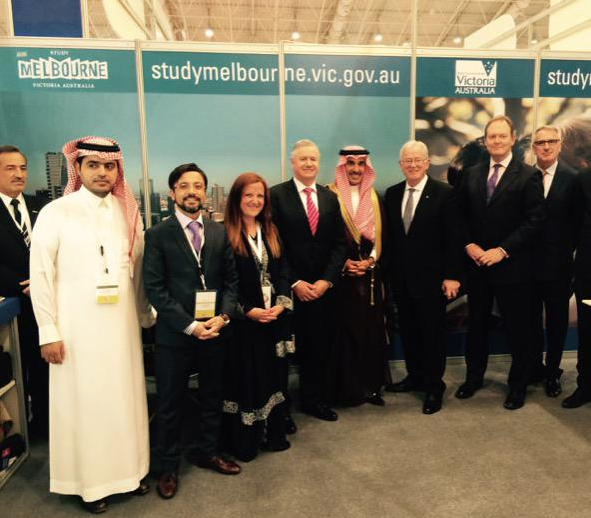 The Ambassador of the Custodian of the Two Holy Mosques in Australia, H.E Nabil Bin Mohammad Al Saleh has emphasised the importance of the recent visit of the Trade and Investment Minister Andrew Robb and various other senior Australian businessmen to the Kingdom of Saudi Arabia and the Gulf Countries.
The Ambassador has stated that this was an excellent opportunity for Australia to build and strengthen extensive trade relations with key partners in Saudi Arabia and across the Arab world. He also stated that this visit reflected the current strong trade ties between Australia and the Arab world.
During their two day visit to Saudi Arabia the Trade Minister and his delegation met with a large number of senior officials in the Kingdom, including the Minister of Commerce, Dr. Tawfiq Al Rabia, the Minister of Economy and Planning, Dr Mohammed Bin Suleiman Al Jasser, the Minister of Agriculture Abdul Rahman Bin Abdul Mohsen Al Fadhli, the Governor of Saudi Arabia General Investment Authority (SAGIA), Abdullatif Bin Ahmed Al Othman, GCC Secretary, Abdul Latif Bin Rashid Al Zayani, Deputy Minister of Finance, Dr Hamad Bin Sulaiman Bazei and also the Vice Chairman of the Chamber of Commerce, Mr Saleh Bin Hassan Afaleq.
On his part, the Australian Minister of Trade, Andrew Robb, stated that his trip was an important opportunity to extend their trade relations with Saudi Arabia. Minister Robb also emphasised the importance of resuming free trade negotiations with the Gulf Cooperation Council States.
Minister Robb also attended a meeting with the Saudi Business Council of Australia held in the Saudi Chambers in Riyadh Council. This meeting was headed by Abdul Latif Bin Misfer Al Zahrani on the Saudi side and Tom Harley on the Australian side. H.E Ambassador Nabil Al Saleh was also in attendance, along with Ambassador of Australia to the Kingdom Ralph King. During this meeting the two sides discussed bilateral relations between the two countries, particularly in regards to the fields of economy and investment and ways of enhancing them on both sides.
Recent Posts
- Saudi surgeons successfully separate Fijian conjoined twins
- Al-Issa’s visit highlights Australia’s multifaith future
- Saudi Ambassador to Australia Receives Muslim World League Secretary-General
- Australian Saudi Business Council and Forum hosts Ramadan iftar in Sydney
- Saudi Heritage Shines at Canberra’s National Multicultural Festival 2026
Recent Comments
Archives
- October 2026
- April 2026
- March 2026
- February 2026
- September 2025
- August 2025
- May 2025
- February 2025
- September 2024
- June 2024
- May 2024
- February 2024
- November 2023
- October 2023
- September 2023
- April 2023
- March 2023
- February 2023
- December 2022
- November 2022
- October 2022
- September 2022
- July 2022
- September 2021
- July 2020
- February 2020
- January 2020
- September 2019
- February 2019
- January 2019
- March 2018
- February 2018
- January 2018
- December 2017
- November 2017
- October 2017
- September 2017
- August 2017
- December 2016
- November 2016
- October 2016
- September 2016
- August 2016
- June 2016
- May 2016
- February 2016
- January 2016
- December 2015
- October 2015
- July 2015
- May 2015
- April 2015
- November 2014
- October 2014
- August 2014
- July 2014
- April 2014
- March 2014
- February 2014
- December 2013
- November 2013
- October 2013
- September 2013
- August 2013
- July 2013
- June 2013
- May 2013
- April 2013
- February 2013
- December 2012
- October 2012
- September 2012
- August 2012
- July 2012
Categories
- 2009
- 2010
- 2011
- 2012
- 2013
- 2014
- 2015
- 2016
- April
- April
- April
- Arabic
- August
- Combatting Terrorism
- December
- December
- December
- December
- December
- December
- English
- February
- February
- February
- February
- January
- July
- July
- June
- June
- June
- June
- March
- March
- May
- May
- May
- May
- November
- November
- October
- October
- Photo Gallery
- SA News
- SA TV
- Saudi Australia Relations
- SAUDI BULLETIN
- Saudi Issues
- Saudi Vision 2030
- September
- September
- September
- September
- September
- September
- Uncategorized